
Metallic Color Incense Sticks

Metallic Color Incense Sticks
(+84) 946 02 6622 (Whatsapp/Viber/Zalo)  www.rawincense.com
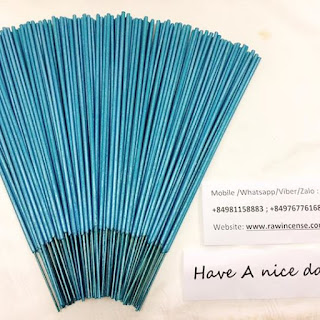
We are the famous Exporter, Manufacturer & Supplier of White Incense Sticks in Vietnam.
- Size: 8"", 9"", …etc- Counting 8"": 1000 to 1050 pcs/kg- Counting 9"": 900 to 950 pcs/kg- Color: red, pink, green, blue, copper, purple, golden, silver,...


GMEX.,JSC
All raw incense stick, incense stick best price
(+84) 946 02 6622; (+84) 98 115 8883(Whatsapp/Viber/Zalo)
Email: info@gmex.vn | sale@gmex.vn | salegmex@gmail.com


Comments

Popular posts from this blog

HOW TO MAKE INCENSE STICKS

How to make incense sticks In the last essay, I told you about the first process of manufacturing agarbatti and today you’ll know the rest ! Moreover, after reading my two short writings, you will be absolutely able to make incenese sticks on your own. Process 2 : HOW TO MAKE INCENSE STICK (AGARBATTI) Step 1 : Mix powder What you need : Charcoal powder , wood powder , Joss powder (Other name : Glue powder, Jigit powder, Litesea Glutinosa) This is very easy , you can collect burned wood powder and grind its. Coconut cell powder or bamboo burned powder are very good to use as charcoal power for sticks. F irst mixed the above materials to following ratio (formular): Wood en glue : Charcoal powder : sawdusts /wooden powder =   1 .5 :5 M ixed them all together and we call this is pre-mix powder. Add more water 50% of total mixing powder weight . **Kindly note: all ratio is relatively, not exactly. Its depend on the quality of pow...

Vietnam joss powder, Vietnam wood powder, Vietnam T1 wood powder, Vietnam charcoal powder

This research investigates the wettability of selected wood species from Vietnamese community forests, jabon (Anthocephalus cadamba), gmelina (Gmelina arborea.), Manglid (Manglietia glauca), rubber wood (Hevea brasiliensis), and sengon (Paraserianthes falcataria). The study measures the contact angle and evaluates the suitability of these wood species for plywood production. Logs from a community forest were processed to convert into thin slices of veneer using the ro tary cutting method at a plywood plant. Subsequently, the study analyzed the wetting behavior of the veneer samples resulting from a rotary process on tangential surfaces without smoothing treatment with distilled water. The veneer was then made into plywood using an adhesive nanofiller of phenol formaldehyde mixed with wood bark powder. Ball milling produced nanofillers from the bark of jabon, gmelina, and surian with nanoscale particle diameter size (10–1000 nm). The bonding strength of the plywood was evaluated under c...

CINNAMON VIETNAM

CINNAMON VIETNAM 1. Plant characteristics and distribution Wood trees, 10 - 20m high, smooth bark. The staggered leaves have short, long or slightly stalked stalks, with 3 arched tendons. White flowers, which grow into clusters in the leaves or the ends of the branches. Egg-shaped nodules, when ripe, have a smooth purple color. The whole tree has the aroma of cinnamon. Much grown in northern provinces in Vietnam. According to new studies, C. cassia is a native cinnamon species of Vietnam that is popularly grown from the northern provinces to the southern provinces of the Central Region. Localities growing cinnamon with large areas are: Yen Bai, Quang Nam, Quang Ngai, Thanh Hoa, Nghe An and Quang Ninh. Vietnamese cinnamon species. 2. Growing cinnamon  and exploitation Particles split seeds. Sowing seeds in culture, when young people are strong at 0.6 - 0.7m, they are poor. After 10 years,  in year maybe exploitation 2 times.  The first:  Apr-May...